

Meditating on the Love of Jesus

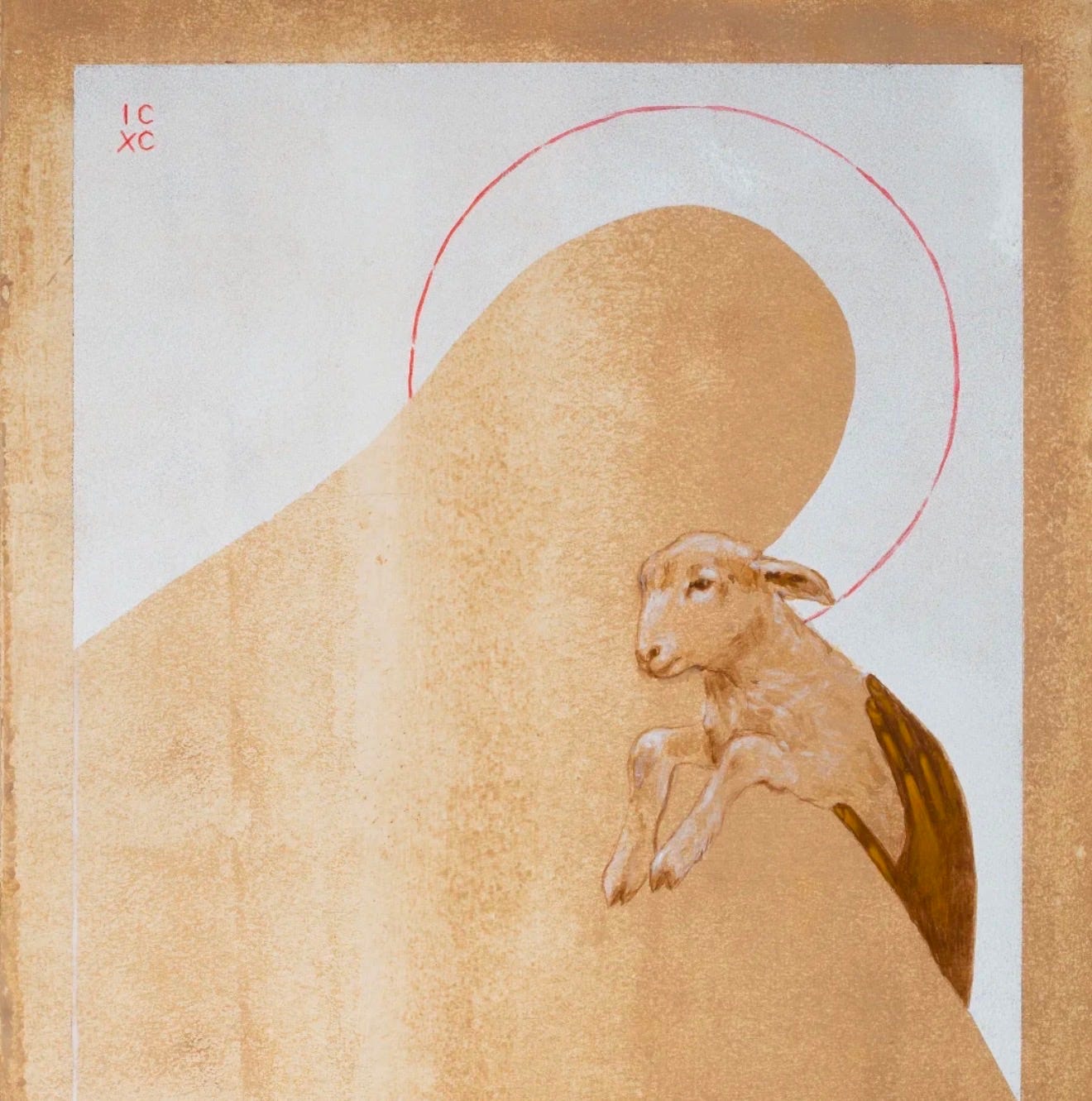
Song of Solomon 1:4 We will extol your love more than wine.
Throughout the Song of Solomon, it’s not unusual for the Bride’s friends to get a few lines. They are like a supporting choir that chimes in to reinforce the poetic and prophetic mutual love in the Song. And here in Song 1:4, the Bride’s friends are also rejoicing at the great love of the Groom. There’s a subtle lesson for us here.
Verse four sees the pronouns go from “me” to “we” because the Christian life is personal and communal. The Bride talks. The Choir talks. There is my walk with Jesus, and our walk with Jesus. We want to enjoy Jesus in our own soul, and we want to enjoy Jesus in our souls together. And we want to encourage and exhort one another in our walks with Jesus. More specifically, we want to “extol your love more than wine.”
Extol the Love of Jesus—Huh?
We don’t use the word “extol” a lot in English. Maybe ever. And even the most popular translations of the Bible differ in how they translate this Hebrew word, “zakar.”
“Celebrate” (CSB)
“Praise” (NLT, NIV)
“Remember” (KJV)
“Savoring” (Tanakh)
And throughout the Bible, the word gets translated several ways, depending on the context, as:
Mindful
Invoke
Think
Trust
Remind
Remembrance
So, I believe this ingredient list of words shows us a helpful way to think of what it means to “extol” the love of Christ.
This leads me to define it as being meditatively moved by the love of Christ. As we soak in, savor, and reflect on the love of Christ, we are moved to celebrate, praise, and respond to his love. It’s not just cerebral. It’s spiritual. Mind and soul. Doctrine and affection. And, Song 1:4 says we would extol, be more moved by his love “more than wine.” And there are two dimensions to the “more than wine” response.

First, wine does move people. The Scriptures teach that, positively, it can gladden the heart (Psalm 104:14–15), help the stomach (1 Tim 5:23), and be used for joyful occasions (Ecclesiastes 9:23). Negatively, when abused, it can lead to drunkenness (Ephesians 5:18), mocking and fighting (Proverbs 20:1), and lots of ungodliness. I’ve written about this before, but the comparison between being moved by the love of Christ and being moved by wine is a powerful metaphor. Too much wine changes the way you talk, think, respond, feel, and treat others—all in the negative. And when we are filled with the love of Jesus, it also changes our speech, thinking, emotions, and how we treat others. But there’s another thing to consider about wine and the Song of Solomon.
Second, remember, the Song of Songs is a wedding song. And in the Ancient Near East, wine was a fixture of the celebration.1 A wedding in this part of the world, without wine, would be like a Panera Bread with no bread, a Starbucks without coffee. It doesn’t even make sense. This is also why Jesus’s first miracle, turning water into wine, is prompted by the social disaster of the wedding running out of wine.2 We can’t fully appreciate how integral wine was to these ancient weddings, and to life in the ancient world.3
Here’s what we need to see today—Song 1:4 is teaching us that the love of the Messiah, the love of Jesus, is more central, more defining, more important than anything else in our lives—more than wine defines a Middle Eastern wedding. More than water defines the ocean. More than turkey defines Thanksgiving.
Is the love of Jesus the central thrill and enjoyment of your life? Of your church?
We must meditate, focus, linger on the love of Jesus, until it moves us to celebrate—till we experience it. The material for meditation is ripe for the picking. I love this last part to think on from Song 1:4.
The Loves of Jesus
It isn’t obvious in English, but in Hebrew, the word “love” is plural. “We will extol your loves.” So this verse is saying—we will extol, celebrate, trust, and be meditatively moved by your loves, Jesus.
The love of Jesus is multifaceted. And we need help to understand it. This is why the apostle Paul prayed that we would “have strength to comprehend” the love of Christ (Ephesians 3:18–19). Paul’s prayer reveals that the dimensions of Christ’s love are not immediately obvious to us. We kind of get it, but not in full. We need help to know something that surpasses knowing. We need the Spirit’s help as we meditate on the many loves of Jesus. I’ve put together a list for us to meditate on.
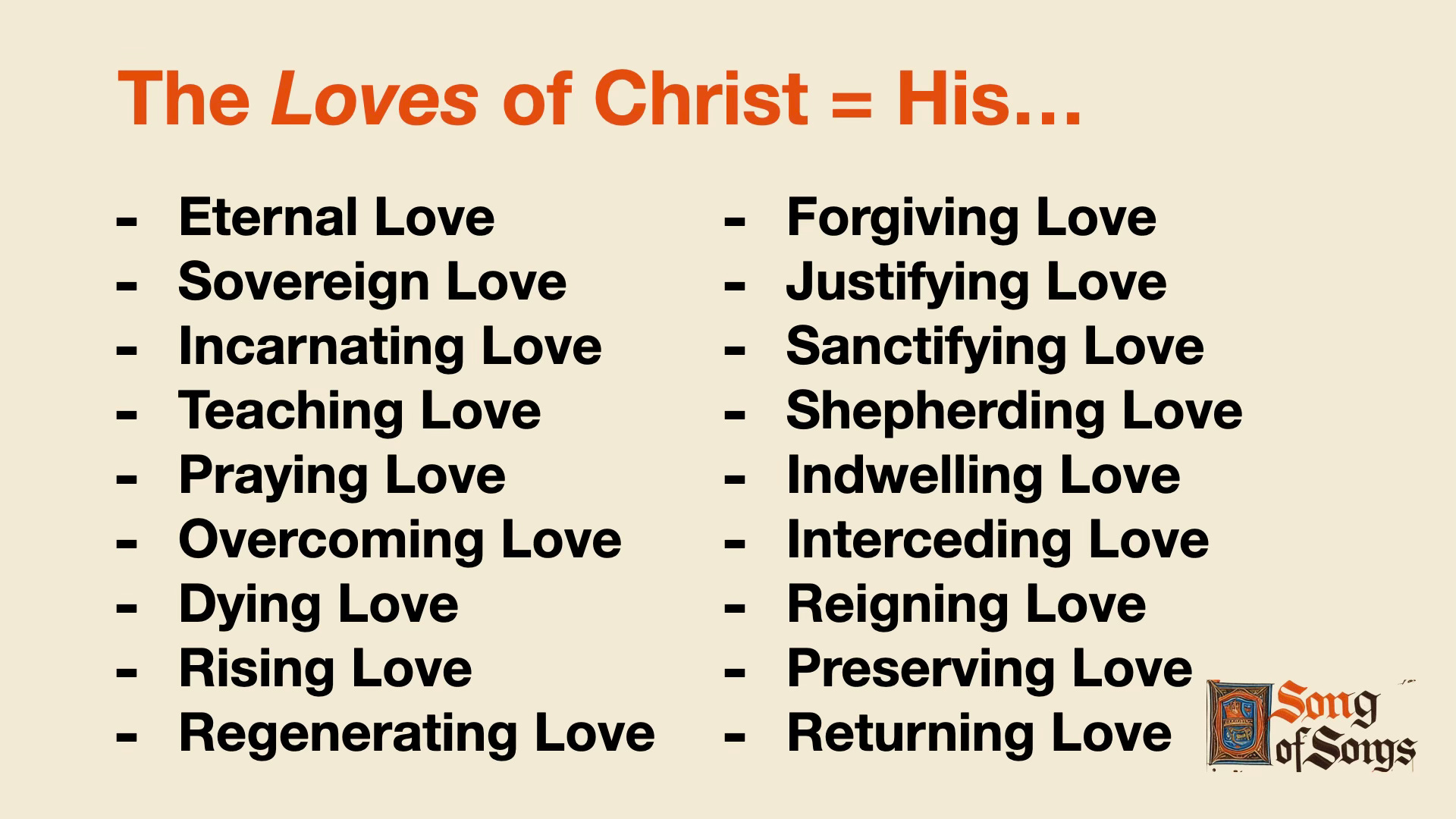
Eternal Love: He loved us before the foundation of the world
Sovereign Love: In love he predestined us for adoption
Incarnating Love: He became a human to save you
Teaching Love: Jesus teaches us because he loves us
Praying Love: Jesus prays for us, thinks of us, cares for us
Overcoming Love: Jesus overcame the world and Devil for us
Dying Love: Jesus went to the cross, died in our place, for our sins
Rising Love: Rising from the dead so we can be raised with him
Regenerating Love: Giving us new hearts, making us born again
Forgiving Love: Casting our sins away, not holding them against us
Justifying Love: Declaring us not guilty, making us righteous in him
Sanctifying Love: Transforming us, helping us become like him
Shepherding Love: He leads us in love
Indwelling Love: Christ comes and lives in us, empowering us
Interceding Love: Jesus prays to the Father for us
Reigning Love: He reigns over the universe for us
Preserving Love: Jesus keeps us from falling away from him
Returning Love: Jesus is coming back for us!
Do you see his love? Do you feel it in your soul? Do you savor it? Does it move you? Look until you see. Meditate until you feel. Praise until he’s palpable.
Take time during the week, during Bible reading and prayer, and meditate on his love. Turn it over in your mind until it warms your soul, your emotions rise, and rejoicing crescendos.
Read this list of his loves, pick one and sit and think over the biblical witness of his love. Recall this aspect of his love and respond to your Redeemer. Meditate until your are moved to worship him. Keep working down the list until your heart is aflame, and a gentle yet worshipful, “Thank you, Jesus,” flows from your soul to his ears.
The more we meditate on the love of Jesus from the Song of Songs, the more we will agree with Charles Spurgeon:
“We see our Savior’s face in almost every page of the Bible, but here we see his heart and feel his love to us.”
If you are new to my spiritual commentary on the Song of Songs, check out these articles:
“The Old Testament recognizes what was common all through the ancient Near East, that wine played a significant role in various types of celebrations: weddings, reunions, banquets, religious ceremonies, etc. But it always recognizes the dangers of over-indulgence…The several references to wine in the Song of Solomon reflect these ideas of excitement and joy associated with it.” G. Lloyd Carr, Song of Solomon: An Introduction and Commentary, vol. 19, Tyndale Old Testament Commentaries (Downers Grove, IL: InterVarsity Press, 1984), 71–72.
Wine’s “absence on special occasions such as weddings was a misfortune, and on one occasion Jesus remedied such a lack by miraculous means (John 2:1–10).” Paul J. Achtemeier, Harper & Row and Society of Biblical Literature, Harper’s Bible Dictionary (San Francisco: Harper & Row, 1985), 1113.
“Wine belongs to the Mediterranean triad of grain, wine, and oil—the main agricultural products in ancient Israel and the major components of the ancient Israelite diet (Deut 7:13; Joel 2:19, 24, 26; MacDonald, What Did the Ancient Israelites Eat?, 19–24). It contributed to agricultural diversity—helpful for times of famine or plague—and provided economic security as a cash crop. Wine also served as an important beverage for an area where drinkable water was scarce due to proximity, drought, or contamination. Because wine was central to the life of ancient Israel, it features prominently in the Old Testament. The presence of wine in the religious traditions of Israel perhaps facilitated its adoption by the Christian community in the Lord’s Supper.” Joseph Kelly, “Wine,” in The Lexham Bible Dictionary, ed. John D. Barry et al. (Bellingham, WA: Lexham Press, 2016).