

Meditations from The Song of Songs
Let the Series Begin

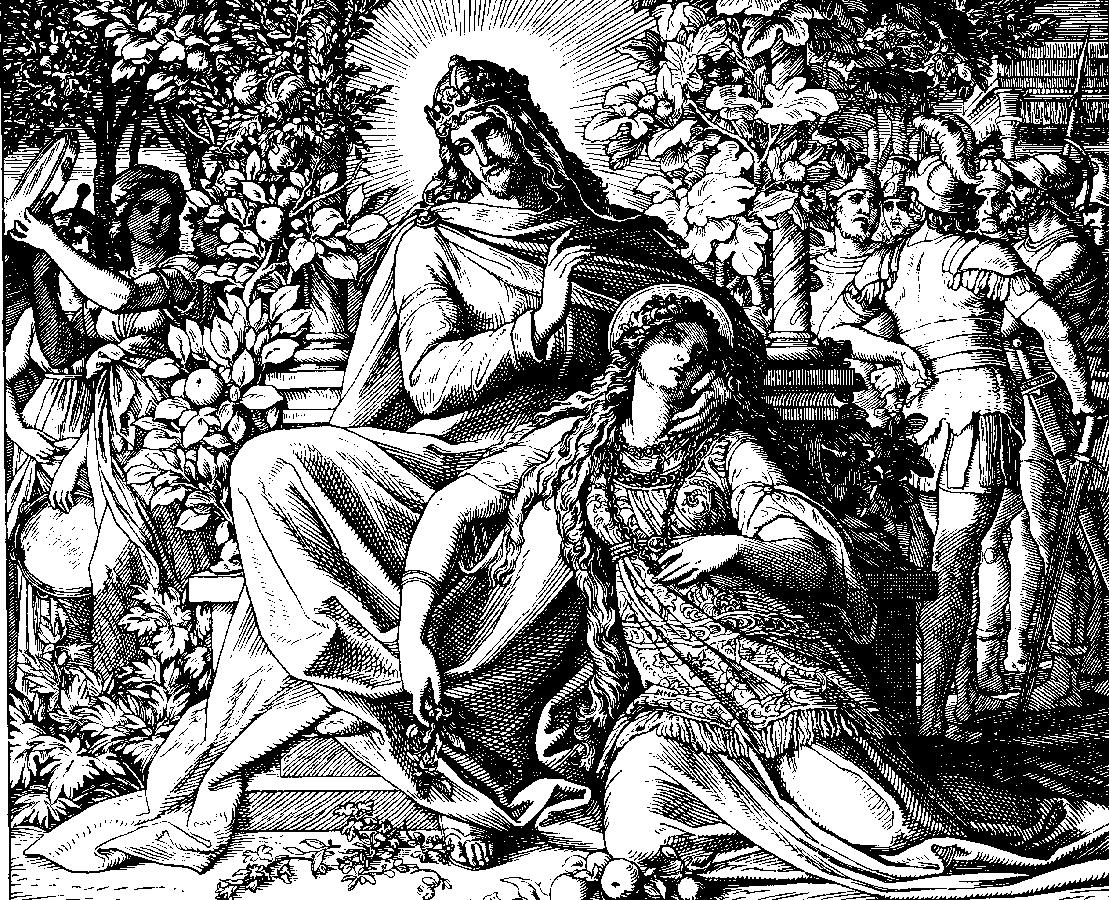
I’m convinced, more and more, of the need to retrieve the spiritual enjoyments of the Song of Solomon. We are missing out when we miss Christ in the Song.
I want us all to savor the Song in the stylings of Jonathan Edwards, John Owen, Richard Sibbes, Robert Murray M’Cheyne, and Charles Spurgeon. If you admire their love for Christ, don’t overlook their love for the Song of Songs—it is connected. They found the Song to poetically present the mutual love between Christ and believers through the mystery of marriage. M’Cheyne called the Song a “parable.” We need spiritual ears to hear what is being sung.
Far from being an awkward book, it is an awesome book. Spurgeon called it a “favorite” book of his.1 I want that for you, too. But, next to Revelation, the Song may be the most uncharted, under-interpreted, and uncomfortable book for the everyday Christian. There is a reason why a meme account is dedicated to how we treat the Song of Songs. Some are pretty funny.

After my doctoral studies in the Song, it is now a life mission to spread the spiritual joys of this spiritual Song.2 Does it sound odd to call this book a spiritual Song? While most of us are familiar with the Song’s physical and sexual messages, the Song is spiritual—it was inspired by the Holy Spirit, for our maturity (2 Tim 3:16–17)—to prophetically point us to the love of the Messiah, Jesus Christ (John 5:39).
So, I’m beginning a collection of brief meditations on select passages from the Song of Songs. We will look at the metaphors and see how they offer fresh dimensions or vibrant reminders of our communion with Christ.
Some of these will be open to all, while most will probably be behind a paid subscription. Let’s begin.
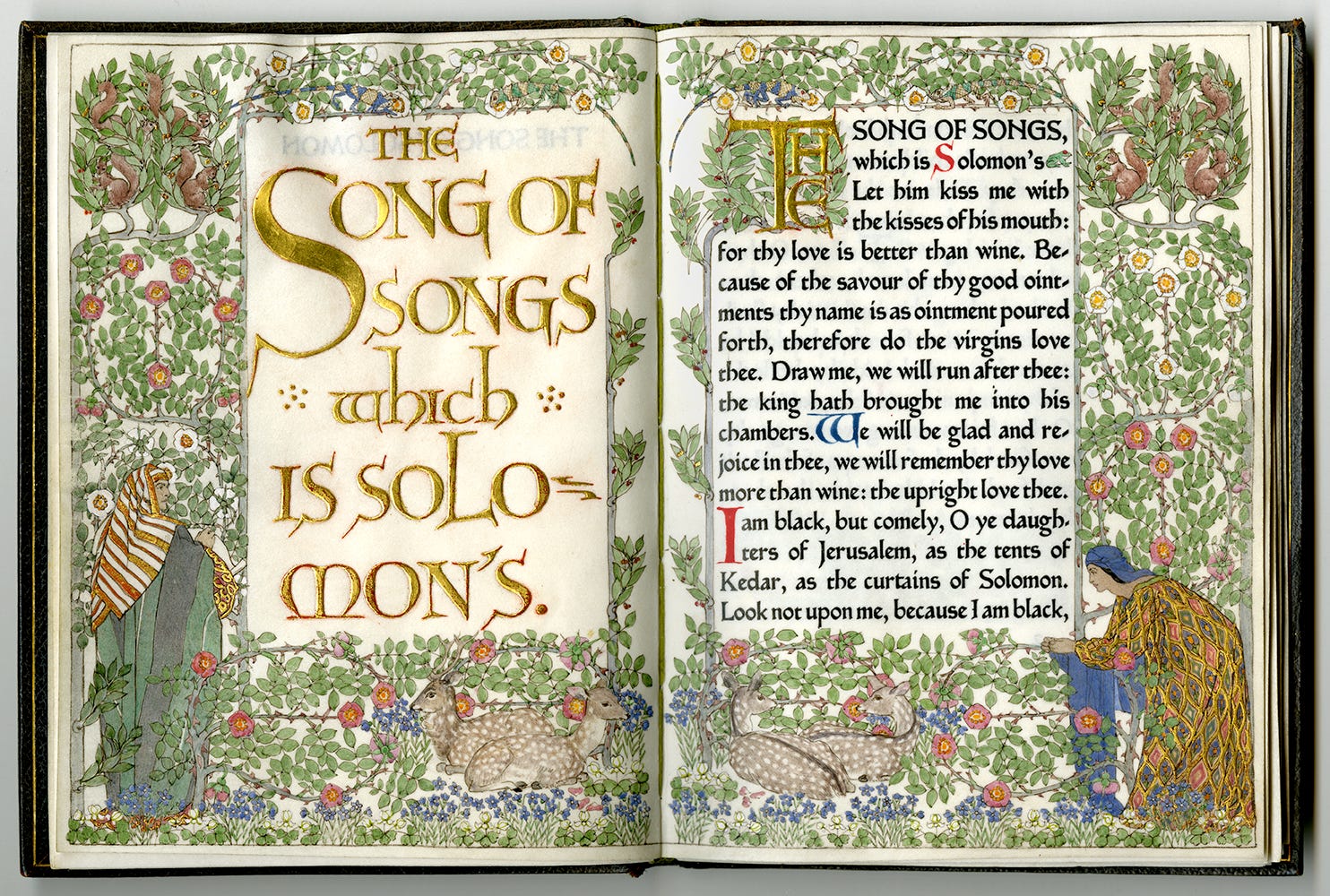
Song of Solomon 1:2 Let him kiss me with the kisses of his mouth!
Spurgeon loved this phrase. He used it over 60 times in various sermons from various books. I could add another chapter to my dissertation on how he used this phrase, but perhaps someone else will take that one! This line is peppered throughout his sermons, revealing how this metaphor flavored his spirituality in at least two ways.
First, this verse demonstrates a prayer for desiring closeness with Christ.
The bride makes clear who she wants love from—“him” and “his.” Her desire is singular. She doesn’t want anything in the way of experiencing the love of her groom. This reminds me of a gospel truth recovered in the Reformation. Christ is the mediator between God and us, but there is no mediator between us and Christ! We have direct access to him. No person stands between the Christian and Christ. We want his love and affection—and we have it. And we ought to long to experience it. This is a prayer for sensing his love. Spurgeon said:
Say, like the spouse in the Canticles, “Let him kiss me with the kisses of his mouth, for his love is better than wine,” and he will answer your prayer, and make your heart burn within you with the holy ecstasy of fervent love.3
Intimacy with Christ, closeness with Christ, communion with Christ—this is the prayer. Spurgeon taught from this phrase that we should, “Seek to get near to him, to come into close contact with him; and when you do so, hold him fast, and do not let him go.”4 He even thanked God for the Song of Songs because without it, we would lack the language to express these heavenly moments with Christ. He said, “These are days when we realize the meaning of the Song of Songs, and bless God that ever the book of Canticles was written, else there would have been in the Bible no expression for our ardent love to Christ.”5 He then went on to rattle off verse after verse from the Song to describe what it’s like to be close to Jesus. Friends, communion with Christ is the prayer. Don’t we want to sense him and his love!?

Notice that it’s plural, kisses. This expresses more than a peck, more than a flicker of experiencing the love of Christ. It’s a desire for more and more from the one who has grace upon grace. And, it reveals the multi-dimensional display of Christ’s love. Incarnation, crucifixion, resurrection, ascension—all kisses of his love. As Scottish preacher James Durham noted, “They are kisses, in the plural number, partly to shew how many ways Christ hath to manifest his love, partly to shew the continuance and frequency of these manifestations.”6
A final spiritual application is to think about the day we will finally see Jesus. Bride and groom together at last!
A day is coming when we will see his face, feel his embrace, and feel his love without the presence of sin. Spurgeon put it this way:
What is to be our heaven? Why, our heaven will be Christ himself, for he gave himself for us. Oh! He is all that we want, all that we wish for! We cannot desire anything greater and better than to be with Christ, and to have Christ, to feed upon Christ, to lie in Christ’s bosom, to know the kisses of his mouth, to look at the gleamings of his loving eyes, to hear his loving words, to feel him press us to his heart, and tell us that he has loved us from before the foundation of the world, and given himself for us.7
Let’s pray to experience the love of Christ. We don’t want any other lovers, idols, or substitutes. We don’t want a mere legal relationship. We want one of love. And so does Christ. He’s given us this verse. He welcomes our invitation.
Second, let’s pray longingly for the day when our love will be sight. We honor our Lord when we eagerly await the marriage supper of the Lamb. The day is coming soon. Let’s continue to get ourselves ready (Isaiah 61:10), as he prepares us for the Day (Ephesians 5:27).
C. H. Spurgeon, “Christ’s Estimate of His People,” in The New Park Street Pulpit Sermons, vol. 5 (London: Passmore & Alabaster, 1859), 462.
I’m thankful for buddies like Patrick Schreiner and Mitch Chase, who are also writing and teaching on the Song. And Jim Hamilton has a new commentary on the Song coming soon. I hope to write a spiritual commentary on the Song one day, too.
C. H. Spurgeon, “A Sad Confession,” in The Metropolitan Tabernacle Pulpit Sermons, vol. 62 (London: Passmore & Alabaster, 1916), 456.
C. H. Spurgeon, “The Object of the Lord’s Supper,” in The Metropolitan Tabernacle Pulpit Sermons, vol. 51 (London: Passmore & Alabaster, 1905), 322.
C. H. Spurgeon, “An Infallible Sign of Revival,” in The Metropolitan Tabernacle Pulpit Sermons, vol. 51 (London: Passmore & Alabaster, 1905), 78.
James Durham, Clavis Cantici: Or, an Exposition of the Song of Solomon (Edinburgh: Thomas Lumisden and Company, 1723), 43.
C. H. Spurgeon, “Christ’s Marvellous Giving,” in The Metropolitan Tabernacle Pulpit Sermons, vol. 62 (London: Passmore & Alabaster, 1916), 247.
Looking forward to this project!