


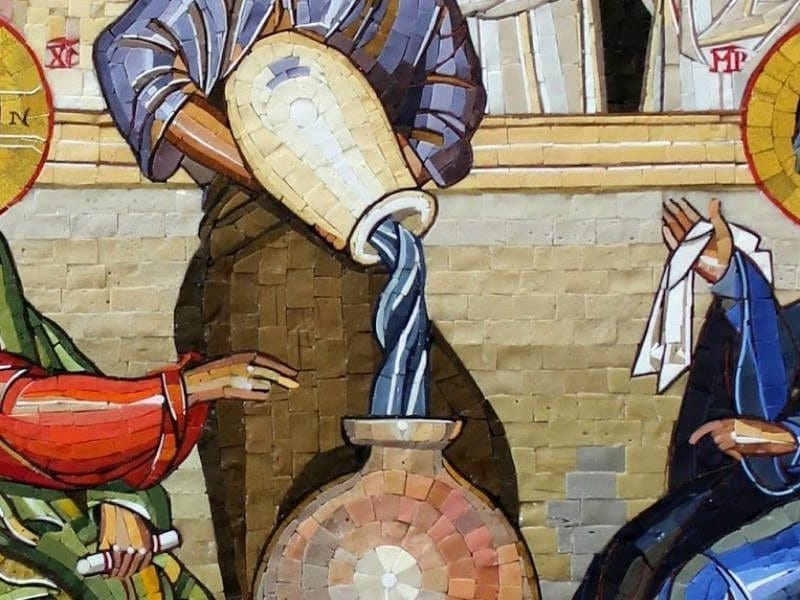
When Jesus turned water into wine at the wedding in Cana, he was doing more than helping out a party that had run dry.
Historical and Theological Background
At a Jewish wedding in the first century, the wine was the groom’s responsibility. One New Testament scholar wrote, “Weddings lasted seven days, and hosts invited as many people as possible, especially distinguished guests like prominent teachers…To run out of wine at a wedding was a social faux pas that would become the subject of jests for years; the host was responsible for providing his guests with adequate wine for seven days.”1
Summary: This is an epic fail from the groom. He sorely undershot the needs of the feast. So, when Jesus provides an abundance of wine (roughly 1,000 bottles), he did help this groom save face and avoid a social disaster—but something deeper happened, too.
It’s important to feel the gravity of this miracle. As D.A. Carson points out, “Jesus’ miracles are never simply naked displays of power, still less neat conjuring tricks to impress the masses, but signs, significant displays of power that point beyond themselves to the deeper realities that could be perceived with the eyes of faith.”2 The apostle John shows us with his comments at the end of the account:
John 2:11 This, the first of his signs, Jesus did at Cana in Galilee,
and manifested his glory. And his disciples believed in him.
These words should cause us to ask three questions about Jesus’s miracle:
What glory was manifested?
Why did this cause the disciples to believe in Jesus?
What did the disciples believe about Jesus?
There is a shared answer to all three.

A unique message was revealed and fulfilled at this wedding, one the entire Old Testament has been building toward—Jesus is the true Bridegroom, Messiah, Savior of God’s people. Thousands of years of history and theology converged in these stone jars as Jesus instructed them to be filled with water. These “purification jars” were now filled with a new wine, a better wine—a foreshadowing of how we sinners can only be cleansed by the wine/blood Christ will give. But there is still more to see here in Cana.
When Jesus stepped in and provided what the unnamed groom failed to do, Jesus was manifesting his glory as the prophesied Bridegroom of God’s people. As one theologian put it, “Before Jesus displayed his wisdom as a teacher, before he exercised his authority as an exorcist, and before he manifested his power as a healer, the first thing he did was perform a miracle in which he, though unmarried, deliberately acted like a Jewish bridegroom by providing wine for a wedding.”3 He revealed his glory as the Husband and Covenant Lover of God’s people, as promised in Isaiah (54; 61; 62), Jeremiah (2; 31), Ezekiel (16), and Hosea.4
Experiencing the Glory of the Groom
Cana revealed the glory of the Groom. The disciples believed Jesus is the Christ, the Groom who would provide a superabundance of super good wine, as noted by the master of the feast (Isaiah 25:6; Amos 9:13; John 2:10). “Jesus’ production of a very large quantity of wine, together with the remark in 2:7 that he filled the water jars ‘to the brim,’ points to the abundance of Jesus’ messianic provision,” and that he is “the bringer of messianic joy.”5 Christ gives gallons of joy to his people, the kind of joy pictured in the prophetic poetry of the Song of Songs.
When Charles Spurgeon preached on Christ’s first miracle, he made a connection to Song of Songs 2:4—a verse about the bride being brought to the banqueting house, or literally, the house of wine, in Hebrew. Spurgeon made a profound observation about the abundance of wine made by Jesus:
Our Beloved has not only brought us to the house of bread, but to the banquet of wine. We have heaven here below. Jesus does not measure out grace by the drop, as chemists do their medicines; but he gives liberally, his vessels are filled to the brim. And the quality is as notable as the quantity: he gives the best of the best—joys, raptures, and ecstasies. O my soul, at what a royal table dost thou sit! He daily loadeth thee with benefits.6
In the Song, we are meant to anticipate the better son of David, who is a Shepherd and a King in Jerusalem, who will bring his bride to an Edenic garden in Jerusalem, where they will enjoy milk and honey. Jesus is the Bridegroom. This is why John the Baptist says about Jesus, “I’m the groom’s best man, and I rejoice greatly at his voice” (John 3:29). He saw Jesus as the prophesied Bridegroom. All the symbolism was realized when Jesus provided the wine in Cana. We learn from the Song how Christ loves, nourishes, and cherishes his bride (Ephesians 5:29). And we are meant to experience his blessings!
Here’s why this is so sweet—just like the groom at Cana, we’ve all failed.
We have fallen short of the glory of God. Jesus is for failures.
Christ saves the day, our lives, our souls through his death and resurrection. Our Bridegroom does what we cannot. He gives what we never could. He blesses in ways we do not deserve. Christ saved us from an eternal disaster. The gospel wine of his blood, uncorked at the cross, is ready for us to drink. So, let’s say to Christ as we behold his glory, “We will exult and rejoice in you; we will extol your love more than wine” (Song 1:4).
Bonus
I recently spoke at Midwestern Baptist Theological Seminary on how the Song of Solomon is about Jesus. The sermon opens with reasons to read the Song in what I’ve termed a “Christoaromatic” fashion, and then I try to show how to enjoy Christ’s person and work.
Craig S. Keener, The IVP Bible Background Commentary: New Testament (Downers Grove, IL: InterVarsity Press, 1993), Jn 2:2–3.
D. A. Carson, John, The Pillar New Testament Commentary (Leicester, England; Grand Rapids, MI: Inter-Varsity Press; W.B. Eerdmans, 1991), 175.
Brant Pitre, Jesus the Bridegroom: The Greatest Love Story Ever Told (New York: Image, 2014), 35.
There are so many verses on this theme, but enjoy these two for starters:
Isaiah 54:5 For your Maker is your husband, the LORD of hosts is his name; and the Holy One of Israel is your Redeemer, the God of the whole earth he is called.
Hosea 2:19–20 And I will betroth you to me forever. I will betroth you to me in righteousness and in justice, in steadfast love and in mercy. I will betroth you to me in faithfulness. And you shall know the LORD.
Andreas J. Köstenberger, “John,” in Commentary on the New Testament Use of the Old Testament (Grand Rapids, MI; Nottingham, UK: Baker Academic; Apollos, 2007), 431.
C. H. Spurgeon, “The Beginning of Miracles Which Jesus Did,” in The Metropolitan Tabernacle Pulpit Sermons, vol. 36 (London: Passmore & Alabaster, 1890), 402.
What a pleasant and thought provoking article! Had not made the bridegroom connection. Thank you for this!