

Feeling Forgiven
Embracing Forgiveness - Part 2

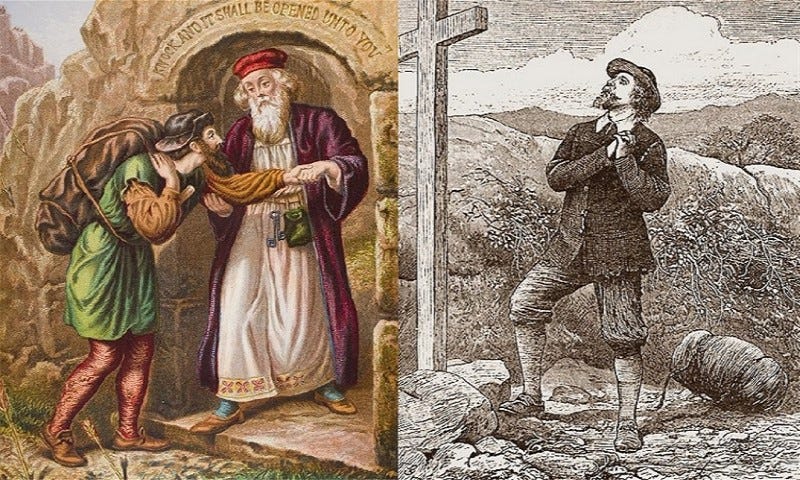
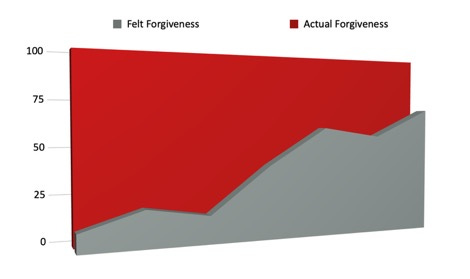
Throughout the Christian life, it is critical to understand that we do not grow in forgiveness from God. But we do grow in felt forgiveness.
We will understand the dimensions of forgiveness as we progress in the faith.
We will grow in gratitude for God’s grace in forgiving.
We will grow in our grasp of the magnitude of God’s mercy in forgiving.
We will grow in thanksgiving, praise, assurance, joy, and so forth. But here’s what doesn’t grow:
There is no 401K of forgiveness that accrues forgiven-ness. It’s done. It’s settled. It is fuller than full from the one who “from his fullness we have all received, grace upon grace” (John 1:16). C.H. Spurgeon put it well in a sermon on 1 John 2:12 when he said:
The forgiveness of sins is not a matter of degrees or of growth. It is done in an instant, and done for ever, never to be reversed. The child of God who was born but yesterday is not as completely sanctified as he will be; he is not as completely instructed as he will be; he is not as completely conformed to the image of Christ as he will be; but he is as completely pardoned as the full-grown saint.
The new Christian, “the little child” (1 John 2:12), is just as forgiven and accepted by God as someone with decades of discipleship with Christ.
In each stage of the spiritual life, we don’t advance in justification—being declared righteous because of Christ—but we will grow in feeling, perceiving, and even enjoying our justification. No one advances in the actuality of the no-condemnationness we have in Christ (Romans 8:1). But we grow in feeling it, understanding it. This chart may help.
Are you blown away by the fact that you are just as justified as John the Apostle, Augustine, Martin Luther, Corrie Ten Boom, that missionary friend, and your pastor? And get this—Christian, you are now, by way of God’s gracious declaration, just as righteous as the holy Son of God. That’s the gospel of grace.
• “For our sake he made him to be sin who knew no sin, so that in him we might become the righteousness of God” (2 Corinthians 5:21).
• “And because of him you are in Christ Jesus, who became to us wisdom from God, righteousness and sanctification and redemption” (1 Corinthians 1:30).
• “And be found in him, not having a righteousness of my own that comes from the law, but that which comes through faith in Christ, the righteousness from God that depends on faith” (Philippians 3:9).
At the cross, a great exchange—a gracious swap-meet—happened between you and Jesus Christ. He took your sin, and you got his right standing before the Father. His account of acceptability to our Father in Heaven was wired to your account. And this exchange didn’t merely bring your account before God to a zero-sum, and now it’s all up to you to show God you deserve eternal life. No, no. When the righteousness of Jesus hit your account, it brought your negative balance to zero, and then it kept climbing —up and up and up—and now you sit with an infinite balance of righteousness with the risen Christ.
You have a non-perishable uprightness that is “not your own”—you didn’t achieve it—but is yours by grace through faith in Christ.
The gospel is this simple. This great. This amazing.
You are actually forgiven, because God has declared you righteous in Christ. And God never lies. And God knows we will struggle with sin; that’s why we confess our sins to God so that we can agree with him on two fronts:
This is sin.
I am forgiven in Christ.
1 John 1:8–9 If we say we have no sin, we deceive ourselves, and the truth is not in us. If we confess our sins, he is faithful and just to forgive us our sins and to cleanse us from all unrighteousness.
Confession is a channel of remembering God’s forgiveness. Unconfessed, harbored, and hidden sin is a rejection of grace. Confession is agreement with God’s word and ways. Repentance is alignment.
Infinite Mercy
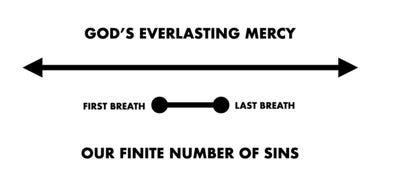
God has infinite mercy for our finite sins.
We can’t out sin God’s mercy. He’s eternal; his mercy is everlasting. In contrast, we are finite; the dates on our tombstones limit the number of our sins. Our sins are no match for the eternal God’s unfailing love.
The apostle John wants every Christian to be assured of their forgiveness from God: “I write these things to you who believe in the name of the Son of God, that you may know that you have eternal life” (1 John 5:13). John knows the turmoil, doubts, and fears we can experience around forgiveness. He wants us to look squarely at Christ and know eternal life is ours. God wants us, his children, to experientially know that eternal life, forgiveness, and freedom from sin are ours in Christ. God wants us to enjoy his forgiveness—to feel forgiven. “Blessed is the one whose transgression is forgiven, whose sin is covered” (Psalm 32:1).
And with this blessed new life in Christ comes the living of that new life. We will cover that in part 3—living forgiven.
I was reading these on the Aquilla Report, then found on here. thanks for your work
Outstanding. I hope to be as clear and concise as this when I'm talking about the gospel.